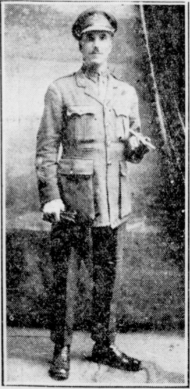
‘The Smartest Man in the British Army’ – Regimental Sergeant Major Byron Edward Rabjohn, 20th Hussars
One of the many jobs the Museum team gets on with behind the scenes is that of research enquiries. This is largely focused on family history research, although we do take requests for more general information (such as regimental postings or actions during specific military engagements, uniform development, etc.). This month’s article stems from a rather interesting family research request we have been working on, the history of Regimental Sergeant Major Byron Edward Rabjohn, 20th Hussars.
Rabjohn enlisted with the regiment on 16th March 1905, aged 18. The regiment were stationed at Brighton, although Rabjohn joined up with a detachment in Canterbury. Between 1905 and early 1914, he moved three times, firstly to Shorncliffe Camp (1906-08), then to The Curragh, Ireland (1908-11), and then to Colchester (1911-14). In 1913 he had risen to Squadron Sergeant Major, and had qualified as a Musketry Instructor. The 11th October 1913 edition of ‘The Army and Navy Gazette’ noted that he had also passed a course in the Maxim gun at the School of Musketry in Hythe, making him qualified to instruct in its use, as well as the more customary rifle.
Upon the outbreak of the First World War, the 20th Hussars embarked for France, but Rabjohn remained at Colchester. Whilst here he was posted to the newly formed 13th Reserve Cavalry Regiment (13 RCR). The RCR were staffed by experienced cavalrymen, and they would be responsible for training new recruits, as well as mobilising reservists. 13 RCR trained men for the 14th and 20th Hussars, the Bedfordshire Yeomanry, and the Hertfordshire Yeomanry. By the time of Rabjohn’s transfer, he had been appointed a Squadron Quartermaster Sergeant. The following quotation, taken from the memoirs of Albert Elliot ‘Smiler’ Marshall, the last surviving cavalryman of the First World War, suggest that Rabjohn had a positive reputation amongst the recruits:-
‘… at the end of the hunting season I volunteered for France, and I was sent to the cavalry barracks at Colchester to be trained with the 20th Hussars by Sergeant Rabjohn – said to be ‘the smartest man in the British Army’.’
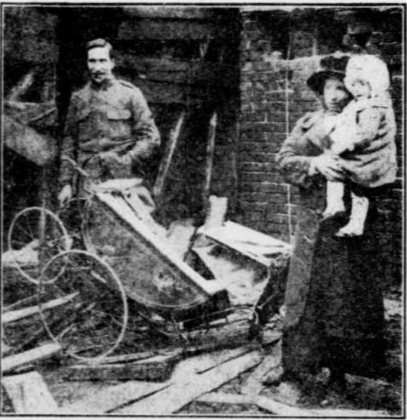
On 21st February 1915, Rabjohn’s family home, located at 41 Butt Road, Colchester, was bombed during a German air raid, whilst Rabjohn’s family were still inside. The below is an extract from ‘The Kent Messenger’ of 27th February 1915, detailing just what had happened:-
‘At about 8.40 on Sunday evening last, a bomb was dropped by a hostile aircraft at Colchester. It was probably meant for the artillery barracks, but as a matter of fact it fell in the garden at the back of 41 Butt Road, occupied by Quartermaster Sergeant Rabjohn, 29th Hussars,
… The quartermaster-sergeant and his wife were sitting in the front room, just about to have supper, when there was a loud explosion at the back and several shrapnel bullets flew into the sitting room. One of them smashed a gas mantle, and another struck pictures in the room, but neither of the occupants was injured. In the kitchen all the furniture was wrecked, as also was the upstairs landing.
In the bedroom, a baby aged one year and ten months was uninjured and not even awakened, although part of the bedroom ceiling was smashed, while downstairs its perambulator [pram] was among the things which were destroyed.
A corrugated iron shed in the back yard was smashed to pieces, a five feet hole was made in the yard, and the windows of four adjoining houses were shattered.’
Gifts of a new pram (the best that could be found from Harrods!) and replacement furniture was passed along to Rabjohn and his family by Lady Colebrooke, the wife of Lord Colebrooke, Captain of the King’s Gentlemen-at-Arms, and an anonymous firm of London furnishers.
A near-miss from the bombing would not deter Rabjohn from his military life, however, as he embarked for overseas service in July 1915. He, alongside 11 other men, would join the rest of the 20th in France on 22nd July, at Les Trois Rois, close to Cassel, Northern France. At the end of March 1916 he was appointed Regimental Sergeant Major, a position he remained in until 1922.
The London Gazette of 3rd June 1919 states that RSM Rabjohn was awarded the Military Cross ‘for exceptional gallantry and devotion to duty’. He was one of only 18 Cavalry Warrant Officers to receive the award, and one of two in the 20th Hussars. Rabjohn remained with the Regiment following the end of the war, returning to Colchester in March 1919. He would not remain in England long, however, as the regiment embarked for Egypt in July, stationed at Tel-El-Kebir.
In 1920, with the 20th, he moved to Turkey, joining British forces stationed there who were operating against Turkish Nationalists. In January 1922, with the 20th Hussars being reduced in size during peacetime, Rabjohn was transferred into the 13th Hussars. They soon amalgamated with the 18th Hussars in November that same year, forming the 13th/18th Royal Hussars, with Rabjohn as their first RSM. In 1924 he was awarded The Long Service and Good Conduct Medal, recognising 18 years of military service. He would remain in post until 31st July 1929. His conduct was recorded as exemplary.
Just after the outbreak of the Second World War, aged 52, Rabjohn re-enlisted into The Royal Armoured Corps in October 1939. At some point in the war, we have no record of when unfortunately, he was posted to the 53rd Training Regiment Royal Armoured Corps, as the RSM. It is unlikely that he served abroad, as the only medals he was awarded for the War were the Defence Medal and War Medal. He was formally discharged on 30th April 1943, marking a, combined, 28 years of exemplary military service.
The above research was undertaken following an enquiry from RSM Rabjohn’s family, and we were most pleased to be able to provide them with the fascinating story of Rabjohn’s service. We think the story of his, unfortunate, bombing was an interesting anecdote to uncover. It is these more personal events that truly help to flesh out the person behind the uniform.
Should you have family history that you are looking to research, please do enquire with the museum. We are always happy to help. An initial search of archives (up to 1 hour) is free of charge; however more in-depth research has a fee of £30. Click HERE for more information.